
AI isn’t knocking on the door anymore, it has already moved in. Open any app today and you will see it quietly at work: curating playlists, answering support chats, sketching UI layouts, even writing chunks of code. AI application development has turned what once needed armies of developers into something that can be sparked by a single sentence fed to an AI model.
Just last year, “how to build app with AI” sounded like tech folklore, i.e., fascinating, but far-fetched. Fast-forward to 2026, AI is no longer just assisting development; it is co-creating apps alongside humans.
App builders are using AI to spin up wireframes, generate backend logic, and train models before their first coffee gets cold. And the numbers echo this shift. According to Statista, the AI market is projected to grow at a CAGR of 36.89% from 2025 to 2031, reaching an estimated value of USD 1.68 trillion by 2031.
So here is the real question: if AI can now help anyone build an app, how do you build one that stands out? This guide walks you through exactly how to build an AI app with speed, clarity, and strategy.
Want to Develop a Custom AI Application for Your Business?
Table of Contents
How to Build an AI App: 8 Step-by-Step Process
When you start thinking about how to develop AI app solutions that actually work, know that it is less about luck and more about strategy. Just boilerplate coding won’t work; to bring profit, you need data-driven insights, and speaking of profits, here is a stat.
According to Stanford HAI, there’s been a revenue increase in 71% of companies that use AI for marketing, and 63% in supply chain management. You are so close to being one of those companies, and here are 8 steps on how to build an AI app.
These steps are not just for creating an app using AI from scratch; you can also rebuild your existing product by using the following steps.
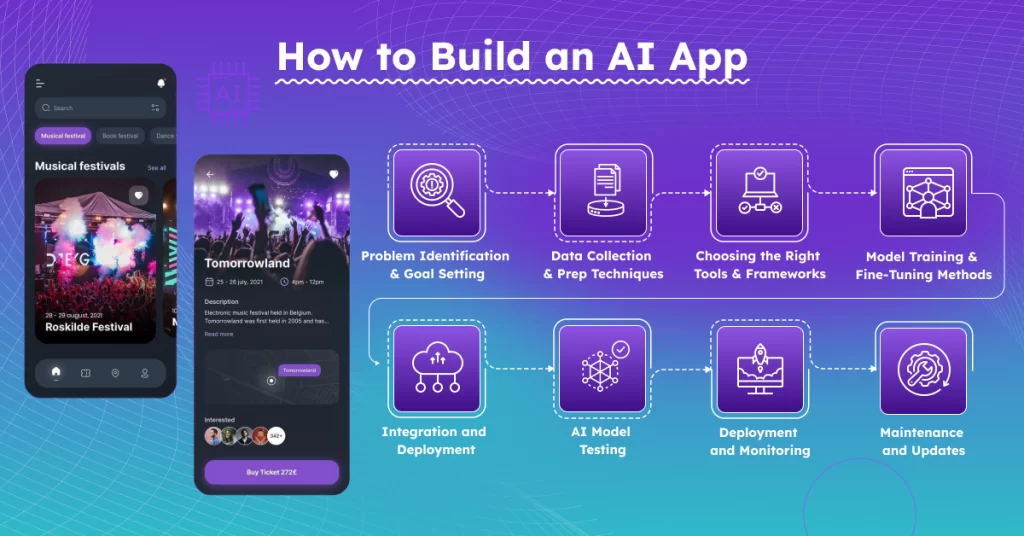
Here are the 8 focused steps to move from a spark of an idea to a working AI app with the help of AI development companies.
1️⃣ Define the Problem & Set Clear Objectives
Every winning app begins with one thing i.e., a problem statement. Before you burn cash on development, pause and ask: what real-world headache is this app solving, and where does AI genuinely fit in?
Are you automating tedious tasks, personalizing user journeys, or predicting behaviour like a pro? Start by mapping user pain points, collect brutally honest feedback (yes, even the stuff that stings), and figure out where AI can create real impact.
If you want to know how to create AI app for your business that users actually need, this clarity stage is non-negotiable. Otherwise, you will end up with an app no one asked for. Set specific, measurable goals: What KPIs will lead to success? What user actions should improve? These goals will anchor your scope, and keep your roadmap clear.
2️⃣ Gather and Prepare Quality Data
Once you have locked your app’s goal, start gathering relevant data from your internal tools, public repositories, third-party vendors, or honestly, anywhere credible you can get your hands on.
But collecting isn’t enough. Messy data is like hiring an intern without an orientation, chaos guaranteed. Clean it up; remove duplicates, fix formats, label things correctly, and split it neatly into training, validation, and test sets. This isn’t some glamorous work, but it is what decides whether your model is learning faster or not.
If you are thinking about how to make an app with AI in 2026, think ahead, maybe your app will need real-time data pipelines for continuous learning. Because at the end of the day, AI isn’t just about fancy models. It is about the ecosystem of data feeding them. Get that right, and everything else runs smoother.
3️⃣ Select the Right Tech Stack & Frameworks
Here is where many teams go on a full shopping spree. Downloading every framework that promises and ending up with a tech stack that is cluttered and confusing.
When you create an app with AI, resist that urge. Start by picking core languages and frameworks that match your app’s goals; not just what is trending on Twitter. If your AI app leans on natural language, look at LLM frameworks and NLP libraries. If it is heavy on predictions or analytics, look for ML toolkits/cloud AI services.
Also, don’t ignore infrastructure. Figure out where this AI app will go live (cloud, hybrid, or on-prem). Remember, scaling later is easier if you build smart today (and way cheaper than panic-rebuilding mid-launch). And please, choose tools your team actually understands. Cutting-edge tech is cool until no one on your dev team knows how to debug it.
Require Scalable AI Architecture & Cloud Deployment Support?
4️⃣ Train and Fine-Tune Your AI Models
Until now it has just been theory and caffeine. This is the moment your app actually starts to think. You will take all that prepped data and train machine learning or deep learning models to spot patterns, make predictions, or spit out outputs that (hopefully) don’t embarrass you in the demo.
Training basically means running data through algorithms, adjusting weights, and watching the model learn. Expect multiple rounds of trial and error. You will tweak hyperparameters, experiment with model architectures, and probably borrow pre-trained models using transfer learning.
And if you are wondering how to create an AI app from scratch, here is the real cheat code: fine-tuning. It is how you take a general model and teach it your domain’s quirks, meaning the slang, the weird behaviours, the niche data patterns.
5️⃣ Integrate AI Into Your App Architecture
Now comes the most important step i.e., taking your trained AI brain and wiring it into your app without breaking everything else. This is where many founders panic, because suddenly it is not just models in a sandbox anymore. It is your actual product on the line.
In AI application development, this is the point where architecture decisions can make or break the entire experience. You can wrap your model as an API, plug it straight into your backend, or deploy it as a microservice floating gracefully in the cloud.
Whatever you choose, design your integration layer to survive traffic spikes and tantrums, because when your users arrive (and they will, right?) latency can kill the vibe.
Also, be deliberate about where AI shows up in your user journey. Place it where it solves a real user problem and feels native to the flow. When done right, it will just quietly do its job.
6️⃣ Test and Validate AI App Performance
Before you release your new AI app to real users (and pray nothing crashes), you need to grill your model. AI is not like regular code, it can behave unusual as well in real-world situations.
Start by running it against your reserved test set to check accuracy, precision, recall. Basically, see if it can actually walk the talk. Then throw edge cases and weird corner scenarios at it just to watch how it reacts. Because if your model breaks when a user does something slightly unexpected, then it would be of no use.
Also, don’t leave it to just your devs. Pull in domain experts to check the model’s output from a business angle. It is not enough that the math is correct, it has to make sense in your actual industry. This is the step that separates “ demo” from “real product” : skip it, and your users will happily find the bugs for you.
7️⃣ Launch with Continuous Monitoring
Finally, launch day. Once your AI app goes live, real work begins. Keep an eye on metrics like prediction accuracy, response latency, user engagement, and error rates. Because AI models age faster than you expect – data drifts, user behaviour changes, and suddenly your “smart” app is giving irrational answers.
Set up monitoring dashboards and automated alerts so you catch issues before users do (nothing kills brand trust faster than your AI giving wrong outputs). Treat deployment like a living, breathing process; keep feeding it new data, reviewing performance, and fine-tuning.
If you are figuring out how to build an AI app that actually lasts, remember that launch isn’t the victory lap, it is just the starting whistle.
8️⃣ Nurture Your AI App Continuously
Congrats, your AI app is live but wait for a moment because AI isn’t a ‘build once, chill forever’ deal. Think of it like that one houseplant you forgot to water: ignore it, and it will wither faster than your weekend plans.
Over time, retrain your models with fresh data, tweak algorithms, and roll out updates based on user feedback. This keeps your app from suffering concept drift. When predictions start going off-track because the real world moved on and your model didn’t.
Also, schedule regular audits for data quality, bias, and compliance (because regulators take things seriously). Make this upkeep part of your product roadmap from day one.
Top 5 Industries Where AI App Is Having an Impact Today
The Forbes CxO Growth Survey of 2025 has found that 93% of 1000 respondents, all of whom were C-suite executives, have reported to increase in their investment in AI over the next two years. Around 56% had planned to increase their AI budgets to 16% or more.
This shows that AI is quietly sneaking into every boardroom agenda (and profit charts right side up). If you are planning to create an app with AI, these sectors are already proof that it is not just hype.
➡️ Healthcare
A number of hospitals use AI apps to scan medical images for early disease detection and answer patient questions at 3 a.m.; the impact is massive.
According to a Forbes October 2025 stat, there has been a 22% increase in AI adoption across healthcare organizations, which is 7 times higher than in 2024 and 10 times higher than in 2023.
Hospitals are using AI-powered diagnostic tools to reduce human error, while pharma companies are using predictive models to slash R&D timelines.
If you are sort of figuring out how to build an AI app for this sector, keep in mind that accuracy, compliance, and speed are the most important.
➡️ FinTech
The finance world has completely stopped trusting gut instinct (and honestly, good call). In a November 2024 Forbes report, it was stated that 76% of financial services companies had launched AI initiatives.
But how to create AI app solutions that function seamlessly and deliver real impact is now rewriting how banks, NBFCs, and fintech startups operate. This includes fraud detection that flags shady transactions in milliseconds to robo-advisors serving personalized investment plans.
If you plan to build an app with AI here, remember: security and regulatory compliance are non-negotiables. Because nothing crashes faster than user trust in finance.